M&S Swansea Flagship Store Closure: What Happened M&S Wales and the Uncertain Future of the High Street
The news sent ripples of concern not just through Swansea, but across the wider retail landscape in Wales. Marks & Spencer, a venerable institution and anchor tenant of Swansea's Oxford Street for decades, confirmed it would close its flagship city centre store. This decision, expected to take effect in late 2026, has ignited a vital conversation about the evolving nature of retail, the challenges facing traditional high streets, and specifically,
what happened M&S Wales in this significant turn of events. For many, M&S isn't just a shop; it's a social hub, a go-to for quality goods, and a symbol of enduring British retail. Its departure from such a prominent location marks a potent moment in the ongoing narrative of urban regeneration and economic adaptation.
Unpacking the Closure: What Happened M&S Wales' Swansea Store?
The announcement on February 24th delivered a "hammer blow" to Swansea, confirming the closure of the Marks & Spencer store situated in the bustling heart of Oxford Street. This particular branch has been a cornerstone of the city centre for generations, drawing shoppers and contributing significantly to the local economy. The company's decision, however, was not made lightly. According to M&S regional manager Richard Owen, the store has been "underperforming for some time," facing "practical and operational issues requiring significant investment." This blunt assessment highlights the fundamental challenges many legacy retail spaces now grapple with.
M&S confirmed that approximately 92 staff members were informed of the closure. A consultation process is underway to discuss potential future roles at other M&S sites, with the company prioritising redeployment wherever possible, a common strategy to mitigate redundancies during such transitions. While the exact closing date is slated for late 2026, the long lead time offers a critical window for both M&S and Swansea Council to strategise.
Richard Owen elaborated on the rationale, stating, “Customer shopping habits are changing, and as part of our UK-wide store rotation programme, we’re adapting our store estate to ensure we have the right stores with the right space to deliver an excellent shopping experience.” This statement is key to understanding
what happened M&S Wales in Swansea; it's not an isolated incident but part of a broader, national strategic recalibration for the retailer. The Oxford Street building, despite its historical significance and prime location, no longer aligns with M&S's modern operational requirements or its vision for a future-proof retail footprint. The need for substantial investment in an outdated building, coupled with its long-term underperformance, made the decision unavoidable from the company's perspective, driven by a need to "prioritise long-term growth decisions."
M&S's Evolving Retail Strategy: A National Shift with Local Impacts
The closure of the Swansea flagship store, while deeply felt locally, is emblematic of a wider transformation within Marks & Spencer's national retail strategy. M&S has embarked on an ambitious "store rotation programme," which has seen it close around 90 historic locations while simultaneously investing in new, often larger, and more modern stores designed for contemporary shopping habits. This strategy aims to create a more efficient and profitable store estate, moving away from older, often multi-floor city centre premises that are expensive to maintain and less flexible for omnichannel retail, towards purpose-built units. For a deeper dive into this overarching strategy, consider exploring
Why M&S Swansea Is Closing: Unpacking the Retailer's UK Strategy.
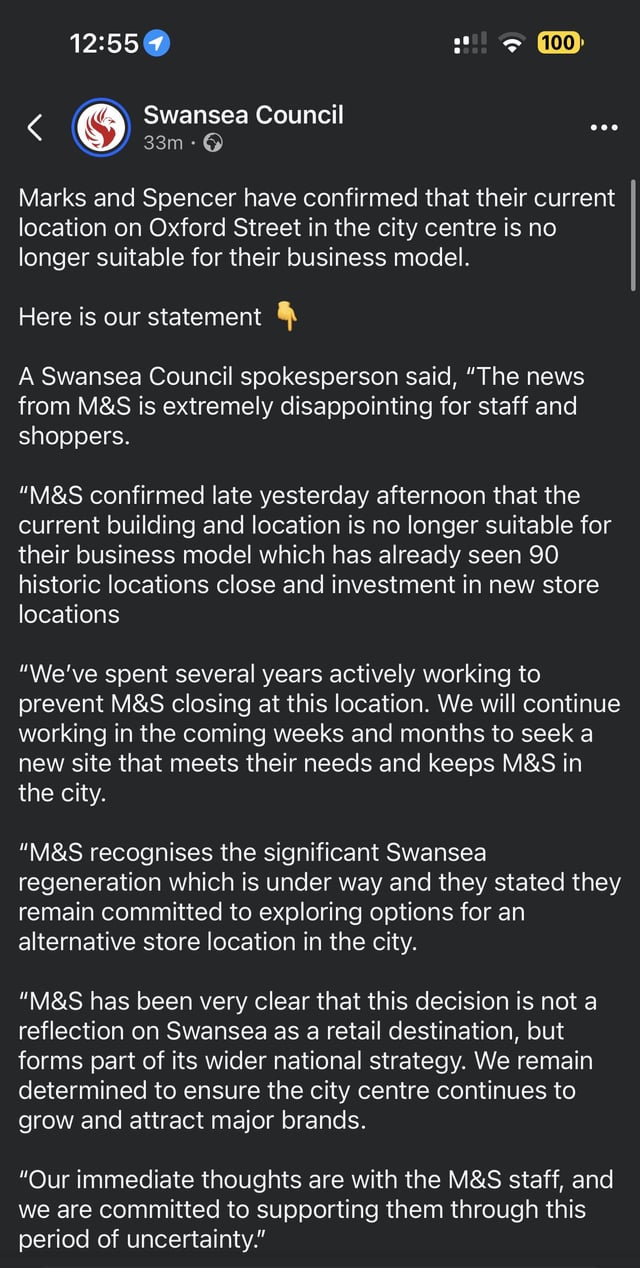
This shift often involves relocating to out-of-town retail parks or modern, accessible city centre developments that can accommodate larger food halls, integrated online order collection points, and ample parking – features that traditional high street buildings often lack. The council's spokesman acknowledged this, noting that "the current building and location is no longer suitable for their business model which has already seen 90 historic locations close and investment in new store locations."
Crucially, this particular closure does not signal a broader retreat from Wales. Marks & Spencer has explicitly reassured that its other stores in Gwent and West Wales – including Haverfordwest at Withybush Retail Park and the Carmarthen town centre branch, as well as stores like the one at Newport Retail Park – are not affected by these latest plans and will remain fully operational. This differentiation underscores that the Swansea decision is based on specific site viability rather than a regional divestment. More details on the security of these other locations can be found in
M&S Swansea Shuts Down: Gwent & West Wales Stores Safe, New Site Hunt On.
Furthermore, M&S has publicly committed to maintaining a presence in Swansea. Richard Owen affirmed, "We will continue serving Swansea customers through those stores and online, whilst we actively look for a suitable location for a future full-line M&S store in Swansea." Swansea Council echoed this, confirming that M&S "recognises the significant Swansea regeneration which is under way and they stated they remain committed to exploring options for an alternative store location in the city." This mutual commitment offers a glimmer of hope that a modern M&S offering might return to the city in a more suitable format.
High Street Headwinds: Implications for Swansea City Centre
The departure of a retail giant like M&S from a prime high street location inevitably raises serious questions about the future of traditional city centres. M&S occupied a substantial retail footprint on Oxford Street, acting as a significant footfall driver for surrounding businesses. Its closure leaves a large void, intensifying "fresh doubts about high street trade in Swansea city centre."
Swansea Council expressed "extreme disappointment" at the news, highlighting their active efforts over "several years" to prevent the closure at this specific site. Their ongoing commitment to retaining M&S within the city limits demonstrates the perceived value of such an anchor tenant. The council's proactive stance in seeking a new site that meets M&S's contemporary needs is critical in navigating this transition.
The challenges facing high streets are multifaceted:
- The Rise of E-commerce: Online shopping continues to capture market share, reducing the necessity for physical visits for many purchases.
- Changing Consumer Habits: Shoppers now seek more than just transactions; they desire experiences, convenience, and value that traditional high streets often struggle to deliver in outdated formats.
- Operational Costs: High business rates, rising energy prices, and increasing labour costs make profitability challenging for physical stores, especially large, old buildings.
- Competition from Retail Parks: Out-of-town retail parks often offer easier parking, larger units, and a more consolidated shopping experience.
For Swansea, this closure arrives amidst significant regeneration efforts, including new developments like the Swansea Arena and various residential and leisure projects. The council is keen to stress that M&S's decision is "not a reflection on Swansea as a retail destination, but forms part of its wider national strategy." Indeed, the ongoing regeneration could provide new opportunities for M&S to find a fitting location that aligns with its future vision and contributes to a revitalised city centre.
The Human Element: Supporting Staff and Community
The immediate impact of the closure falls upon the 92 staff members and their families. M&S's commitment to supporting colleagues through consultation, including finding alternative roles at nearby stores, is a crucial step in mitigating the personal fallout. However, the emotional toll on employees and the wider community, who have shared decades of memories within those store walls, cannot be understated. Local businesses, community groups, and the council will play a vital role in supporting those affected and exploring new opportunities for the space M&S will vacate.
The story of the M&S Swansea flagship closure is a microcosm of the dynamic shifts reshaping retail nationwide. It underscores the urgent need for high streets to adapt, innovate, and offer compelling reasons for consumers to visit, beyond traditional shopping alone. As Swansea looks to the future, the challenge and opportunity lie in transforming this blow into a catalyst for an even more vibrant, diverse, and resilient city centre. The question of
what happened M&S Wales in Swansea reveals not just a corporate decision, but a pivotal moment for urban retail regeneration.